
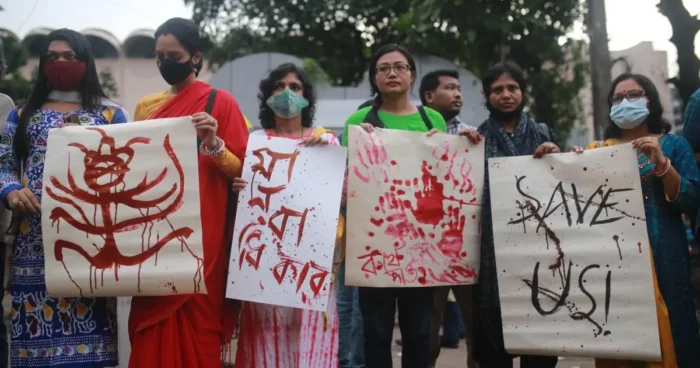
The Bangladesh Hindu Buddhist Christian Unity Council, a leading minority rights organization, has reported a sharp rise in communal violence across the country surrounding the recent national elections, raising renewed concerns over law and order, minority protection, and governance under the current administration.
The interfaith group said it documented at least 133 incidents of violence targeting religious minorities and indigenous communities between January 1 and March 31. The findings, released in a press statement in Dhaka on April 10, paint a troubling picture of insecurity and fear among vulnerable groups during a politically sensitive period.
According to the Council, the incidents included 25 killings, four cases of rape and violence against women, 35 attacks on temples, and dozens of cases involving looting, vandalism, land grabbing, and intimidation. The group noted that the violence was not confined to any single region but spread across multiple districts, pointing to what it described as a “persistent pattern” rather than isolated incidents.
“The continuation of these attacks has left minority communities anxious and concerned,” the Council said in its April 10 statement issued to the media in Dhaka, expressing disappointment that the situation has not improved even after the formation of the new government.
A month-by-month breakdown underscores the scale of the crisis. In January alone, 46 incidents were recorded, including 11 killings and multiple cases of arson, looting, and attacks on homes and places of worship. February saw 50 incidents, including cases linked to allegations of blasphemy, while March recorded 37 incidents, including killings, sexual violence, and continued destruction of religious sites.
The findings come against the backdrop of ongoing political turbulence following the events of August 2024, when an army-backed interim administration led by Nobel laureate Dr. Muhammad Yunus assumed power after the removal of Prime Minister Sheikh Hasina. Since then, rights groups and observers have repeatedly warned of deteriorating security conditions, particularly for communities perceived to be aligned with the previous government.
Human rights organizations have documented widespread abuses during and after the transition. Ain O Salish Kendra reported that at least 318 people, including children, were killed between August 5 and 8, 2024. Meanwhile, the Bangladesh Hindu Buddhist Christian Unity Council recorded more than 2,000 incidents of violence against minorities in the weeks following the political changeover.
Observers say the latest figures suggest that the situation remains volatile despite the passage of time and the consolidation of the current administration. Critics argue that the persistence of such violence points to deeper structural weaknesses in governance and law enforcement.
In its statement, the Unity Council called on the government to take urgent action, including the arrest and exemplary punishment of those responsible, compensation for victims, and proper medical treatment for the injured. It also renewed longstanding demands for structural reforms, including the enactment of a minority protection law and the establishment of a Minority Affairs Ministry and a National Minority Commission.
“The government must act decisively to restore confidence among minority communities,” the Council said, warning that without accountability, the cycle of violence is likely to continue.
Analysts note that communal violence has historically intensified during periods of political transition in Bangladesh. However, they caution that the scale, frequency, and persistence of recent incidents could have lasting consequences for social cohesion and democratic stability.
For many affected families, the crisis is not abstract. Beyond statistics and political debate, the violence has resulted in loss of life, destruction of livelihoods, and a deepening sense of insecurity among communities that have long struggled for equal protection under the law.
No comments:
Post a Comment