
The morning before he died, Dipu Chandra Das left home at first light, stepping out of his tin-sheet house in Bangladesh's Mymensingh city, overlooking a warren of lanes off the highway from Dhaka.
The 28-year-old woke up his father, said goodbye to his wife, cradled his 18-month-old daughter. Then he boarded a bus for the 60km (37-mile) journey to the garment factory where he worked as a junior quality inspector, checking sweaters bound for global high-street brands such as H&M and Next.
His family would not see him again.
Warning: Some readers may find the details below disturbing
Twenty-four hours later, on 18 December, Das, a Hindu, was dead - lynched and burned by a mob after being accused of blasphemy.
Accused of insulting the Prophet Muhammad, he was dragged from his workplace, beaten, hauled more than a kilometre through crowded streets, tied to a tree on a busy highway and set alight before hundreds of onlookers.
The killing sparked global outrage, particularly across the border in India, reviving fears about the safety of minorities since then prime minister Sheikh Hasina was toppled in student-led protests in 2024. About 9% of Bangladesh's 174 million people belong to religious minorities - mostly Hindus. Relations with the Muslim majority have long been marked by periodic tension and insecurity.
Fifty days on, the outrage has ebbed, but grief hangs over the home Das left behind - a single dark room with a beaten-earth floor and tin roof, where the family has lived for nearly 15 years.
It is a house with little furniture or belongings: a plastic table and chairs, beds, sacks of rice, a teddy bear, clothes hanging from a single rail. A refrigerator and a small television - both bought by Dipu on instalments - stand out, quiet markers of a future he was still trying to build.
His mother, Shefali Rani Das, breaks down as soon as visitors enter.
"Oh Dipu, where is my Dipu?" she cries, collapsing into a mournful lament.
Dipu was the eldest son of Rabi Das, a 54-year-old labourer who has spent his life hauling sacks of rice, wheat and vegetables at a nearby market for 400 to 500 taka ($3- $4) a day.
Years of hard work have left him weather-beaten and broken. Dipu wanted him to stop.
"Now I am working," he would tell his father often. "You rest."
Dipu would hand over his salary to the family. He talked constantly about building a proper house, one that would lift the family out of mud and tin for good.
Born at home and raised in a mixed Hindu-Muslim neighbourhood shaped by quiet hardship, Dipu was, by all accounts, a private man with few friends. He left college during the pandemic as lockdowns crushed the family's finances.
By 2024, he was working at a sweater factory, sending money home, and returning from his dorm with chocolates for his infant daughter, spending evenings watching cartoons on TV.
The eldest of three sons, his ambition, his mother said, was to see his younger brothers, Apu, 22, and Rithick, 16, "settled".
Dipu was a small cog in Bangladesh's garment export machine, working for the past 14 months at the Pioneer Knitwear factory. The unit employs about 8,500 workers and is one of nine factories in a group with a workforce of 47,000.
Its sweaters, stitched on long production lines, retail in shops across the US and Europe. Dipu, earning 13,500 taka ($110; £80) a month, checked stitches and seams on one of the factory's hundred production lines. He was one of 868 Hindu workers there.
It was an ordinary life, lived carefully - a young man trying to pull his family out of poverty.
Then came the fateful December evening. A rumour swept through his workplace and outside that he had uttered a 'katukti' - Bengali for an insulting remark - against Prophet Muhammad.
What happened next, in the hours between the allegation and his death, is now the subject of a police investigation.
On the evening in question, a casual chat about weekend plans among three female co-workers near closing time took an uncomfortable turn when Dipu joined in and allegedly made a remark later deemed offensive to the Prophet, according to Mohammed Abdullah Al-Mamun, the additional superintendent of police in Mymensingh, citing accounts from at least three witnesses.
Factory CCTV footage shows Dipu clocking out about 30 minutes after this conversation. He later returned to the floor - footage from two hours later shows him roaming the area, according to Uday Hossain, a senior factory manager.
Why Dipu went back after checking out remains unclear.
Outside a mob had begun to collect as word spread that a factory worker had committed blasphemy. (Bangladesh has no formal blasphemy law, but it criminalises acts "intended to outrage religious feelings".)
As workers poured out at the end of the day, the rumour travelled fast in a busy neighbourhood. By about 6pm, tension had hardened both inside the factory and on the street.
"What followed went far beyond the law," said Al-Mamun.
A mob that began as several hundred at the factory gates demanding Dipu be handed over quickly swelled to more than a thousand, drawing in onlookers from nearby areas. CCTV footage shows men trying to force the gates and hurling ropes over them to climb inside.
At around 20.42 local time, Hossain says, the crowd used shovels to prise open a smaller side gate, poured into the factory, and "carried Dipu away like a wave".
Hossain said the factory had alerted police at least 45 minutes earlier. Yet even as industrial police and officers in plain clothes arrived at the site, they were unable to extract him from the mob, he added.
Police, however, offer a slightly different account of how Dipu ended up in the mob's hands.
They say the crowd threatened to break down the gates if he was not handed over. Faced with that ultimatum, factory workers opened the gate and released him, according to Al-Mamun.
Investigators believe Dipu was beaten to death outside the factory before his body was dragged to a nearby highway, tied with a rope to a tree, and set on fire. "By the time I arrived, he was already dead," Al-Mamun said.
So far, 22 people have been arrested in connection with the incident. Half of those held were Dipu's co-workers at the factory, including two managers of the floor where he worked. An imam of a local mosque has also been arrested.
Most of the suspects are aged between 22 and 30. Police estimate that around 150 people were directly involved in the attack, with many more present as onlookers, while others are still being sought by police.
Few of those arrested, Al-Mamun said, appeared "particularly religious".
"Some are students, some are passersby, some are locals. Everyone was beating Dipu, so they beat him too. But we are treating this as a hate crime."
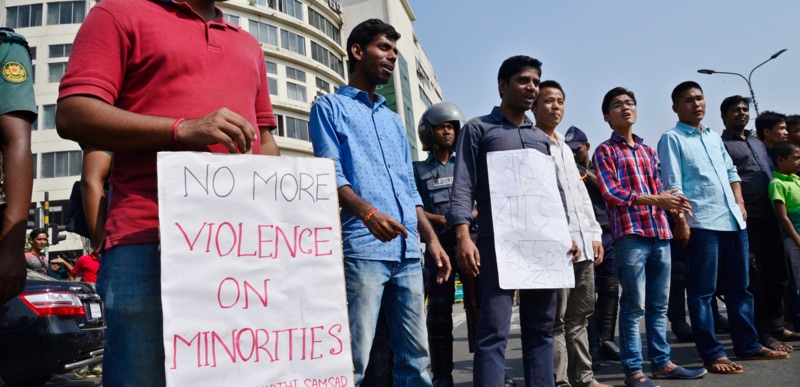
Since the student uprising of 2024, the scale and nature of attacks on minorities - mainly Hindus - have become a fiercely contested question in Bangladesh.
The outgoing interim government says that between January and December 2025, police records show 645 incidents involving minorities but insists that nearly nine in 10 were not communal.
Officials say that most cases involved ordinary criminality - land disputes, theft, extortion, or personal feuds - that were later framed as religious violence. By its count, only 71 incidents had a clear communal element, including 38 cases of temple vandalism, eight attacks on temples, and one killing.
Human-rights groups paint a darker picture.
Ain o Salish Kendra (ASK) records 42 incidents of violence against Hindus in 2025, including dozens of attacks on homes and arson, leaving one dead and 15 injured - numbers that broadly overlap with, but are narrower than, the government's tally.
The biggest divergence comes from the Bangladesh Hindu Buddhist Christian Unity Council, which says violence spiked dramatically after August 2024.
Mainly drawing on media reports, the group says it has documented 2,711 attacks on minorities since August 2024 - including at least 92 killings, 133 attacks on temples and 47 cases of land grabbing - figures far higher than official estimates.
"Minorities in Bangladesh have faced attacks by religious extremists for more than half a century. Governments of all stripes share responsibility. Our numbers have steadily shrunk as many have fled or migrated," Manindra Kumar Nath of the Council told the BBC.
India, meanwhile, says independent sources have documented more than 2,900 incidents of violence against minorities - including killings, arson and land grabs - during the interim government's tenure.
Nobel laureate and outgoing interim government chief Muhammad Yunus has said, "there's no anti-Hindu violence", dismissing such reports as "fake news" by the Indian media. Separately, he has said the attacks were "political, not religious".
Yet, all is not lost. Dipu's killing sparked protests in Dhaka; his employers have cleared his dues and promised to build the house he dreamed of. The outgoing government haspledged $35,000 toward the new home and additional compensation for his family.
"What happened was barbaric, deplorable and shameful. We want the strictest punishment for those responsible," said Badshah Mian, managing director of Pioneer Knitwear. "If this can happen outside a factory, none of us is safe."
That note of solidarity has persisted despite wider tensions.
After Hasina fled the country in 2024, Hindu minorities - often seen as aligned with her secular Awami League in an Islamic state - were attacked by rivals, even as some young Muslim groups moved to protect Hindu homes and shrines.
And ahead of the recently concluded election, Tarique Rahman of the Bangladesh Nationalist Party (BNP) pledged: "We want to build a Bangladesh together - the kind of Bangladesh a mother dreams of," reaching out to people of all religions.
Back at Dipu's home, the night of the killing is recalled in fragments.
A phone call around eight in the evening. A visit to the police station. A father stumbling home to deliver news that shattered the household.
His parents had collapsed. For hours, they were unconscious, neighbours later said - revived with water, then saline injections as the house filled with people and cries.
Nearly two months on, Dipu's mother still breaks down every day. His father has not returned to work. Sleep has vanished. So has appetite, routine, peace.
"Our life has stalled. Nothing is moving anymore," says Rabi Das.
 The incident shows that the interim administration has failed to enforce the rule of law in cases involving political or communal violence. That failure has left the country’s transition in a dangerously exposed state.